
Guest blog by Sholom—
You’ve done the reading. You’ve prayed. You’ve listened to podcasts, talked with trusted mentors or therapists, and committed yourself to living in alignment with your faith and values. Mentally, you know the truth:
- You are inherently worthy and loved by God.
- Your desires and struggles do not make you broken.
- You’ve done nothing wrong by simply existing as a same-sex attracted man.
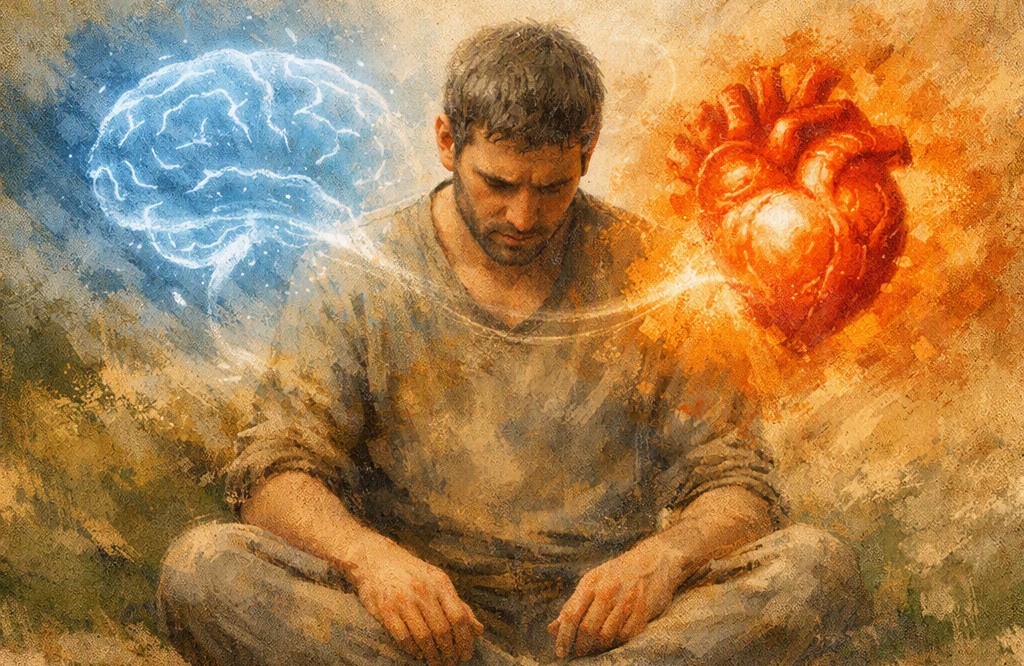
Yet, in the quiet moments—or when triggered by shame, fear, or lonely evenings—that truth feels a million miles away. You know it in your head, but your stomach still knots up and your chest still feels tight.
If this sounds familiar, take a deep breath. That gap between head and heart isn’t a personal failure, nor is it a sign that you aren’t trying or praying hard enough.
This is where the real work lives.
Knowing vs. Feeling: Two Entirely Different Jobs
We live in a culture—and often religious communities—where intellectual belief gets prioritized. We think that if we can just find the right structure, memorize the right scripture or quote, or reframe our thoughts perfectly, our emotions and nervous system will immediately fall in line.
But knowing something and feeling it in your body are two entirely different jobs.
- The Head’s Job: Intellectual processing, logic, and cognitive alignment. It grasps facts quickly. The head’s job is survival.
- The Heart & Body’s Job: Emotional safety, relational trust, and nervous system regulation. It learns slowly through repeated experience.
When you’ve spent years carrying secrecy, fear of rejection, or subtle religious trauma (or anticipation of religious trauma), your body adapted to protect you. It learned to stay on guard. A single intellectual breakthrough cannot instantly erase years of somatic protection.
Why Repeating the Right Words Isn’t Always Enough
Affirmations and truth-telling are an essential start. Reminding yourself of who you are before God provides a critical anchor. However, real internal transformation rarely happens through a single insight or by forcing yourself to “feel better.”
Change tends to happen slowly, through experiences, relationships, and daily practices. Change happens when we slowly teach our nervous system to react differently, over time and when we learn we are safe in the new belief.
If you want the truth in your head to descend into your heart and body, consider these gentle practices:
- Stop Punishing the Gap
When you notice a disconnect between what you believe and what you feel, avoid beating yourself up. Instead of thinking, “Why am I still feeling ashamed? I should know better by now,” try offering yourself grace and kindness (the way you’d probably speak to someone else): “It makes sense that my body feels anxious right now. It will take time for my heart to catch up to what my mind knows.” Even if the initial thought is the shaming one, catching it and meeting it with understanding, goes a long way.
- Move from Cognitive Truth to Experiential Truth
The body learns through lived experience, not just abstract thoughts and ideas. If you know you are worthy of love and community, seek out safe, grounded relationships where you can actually experience being seen and valued as a man living faithfully (even with the same-sex attraction).
- Practice Somatic Grounding
When emotional shame or anxiety spikes, engage your physical senses to signal safety to your nervous system:
- Place a hand over your heart or stomach and feel your breath.
- Look around the room and name five things you can see.
- Take slow, deep exhales to help regulate your body.
- Connect to the moment that is happening around you. The breath ONLY happens right now.
Be Patient with Your Journey
Bridging the distance between your head and heart is a sacred, gradual process. You don’t need to force your feelings to match your theology overnight.
God isn’t waiting impatiently on the other side of that gap, frustrated that you haven’t “fixed” your emotional responses yet. He meets you right in the middle of it—walking with you through every slow, deliberate step toward peace, alignment, and wholeness.
So keep breathing, brother. Keep showing up. Keep letting truth settle deeper into your bones. Because healing isn’t about arriving—it’s about learning to live whole, right where you are.